Week 2 / Planning
Meeting you
From the start
Ugh, what if a lot is too much? We covered macronutrients, and now it feels crucial to eat them all, all the time, in every meal. Perfectly. It's where clarity might have tipped into confusion and that's not what we want. The idea is to give you information you might have been missing but not to draw lines in the sand.
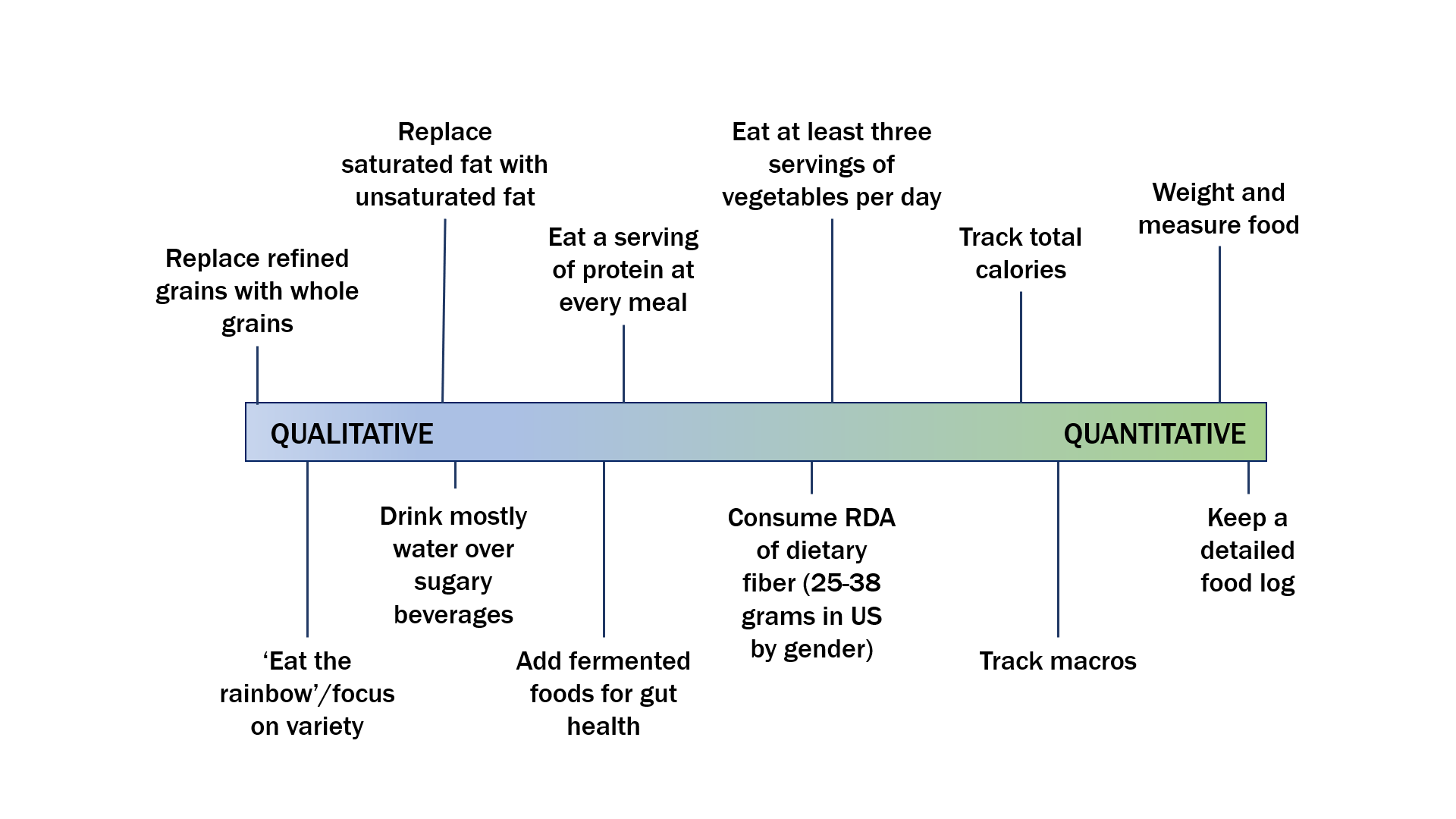
So if we say you need this much protein or that much fiber you're not obligated to hit that target now that you know. Achieving that acceleration is rare - even Formula One drivers start in go-karts. It's why we created a 'Qualitative to Quantitative' chart to give you an idea of how to start. You can still set a goal without exact measures. You can move from left to right picking a qualitative goal - it doesn't have to be one of these - until you feel confident that you've established a habit. Then you can move to a quantitative goal if you want (and you might never want to).
A Smarter Way to Track Without the Rules
If you’re considering food logging but it feels like too much, too soon, there are options. Traditional food logging systems rely on structure: daily checklists, fixed recipes, and a sense of falling behind if you miss a day. AI changes that. It adapts to whatever you’re eating, and however you want to record it, whether that’s a quick note, a photo, or a rough description. You can ask questions in the moment about preparation or portion size, making tracking more like a conversation and less like paperwork.
This is a longer video, but it explains how you can use ChatGPT to log meals. We use an example client to describe what he’s trying to do and what he’s eating, while asking for help when additional support is needed. We use screen recordings to show how it calculates calories and macros, and how it uses food preferences to create a meal. We also find three suitable lunch choices within walking distance by including the meal parameters and a neighborhood to search.