Week 4 / Analyzing and Balancing

The challenges we’re facing and the dreams we’re pursuing are increasingly hard to define, measure, and pin to a set schedule. In fact, a common challenge for many people these days is feeling stuck when it comes to their next steps: instead of providing a motivating force, the idea of setting a well-defined goal is paralyzing. When the future is uncertain, the neat parameters of rigid goal-setting frameworks are of little help;
Le Cunff, Anne-Laure. Tiny Experiments: How to Live Freely in a Goal-Obsessed World (p. 29). Penguin Publishing Group. Kindle Edition.
A B C, It's easy as 1 2 3,
as simple as do re mi,
A B C, 1 2 3
S M A R T, Girl!
You sang that, didn't you? If only SMART goals inspired as much joy and compliance. Anne-Laure Le Cunff notes in her book ‘Tiny Experiments: How to Live Freely in a Goal Obsessed World, “All these approaches to goal setting are based on linear goals: they were created for controlled environments that lend to readily measurable outcomes with predictable timelines.” If this linear approach doesn’t align with what you’re doing you’re not alone.
Why SMART Goals Aren't Always So Smart
(And What to Try Instead)
You've probably heard of SMART goals—those structured goals that are supposed to be specific, measurable, achievable, realistic, and time-bound. And sometimes, that approach works just fine.
But what if the road ahead isn't so clear? What if you're experimenting, learning, or trying to adjust to a new rhythm because of a schedule change? That's where two gentler, more flexible goal-setting tools come in: agile goals and learning goals.
These might be new to you, but don't worry—we'll walk through them together.
Agile Goals: One Step at a Time, Then Adjust
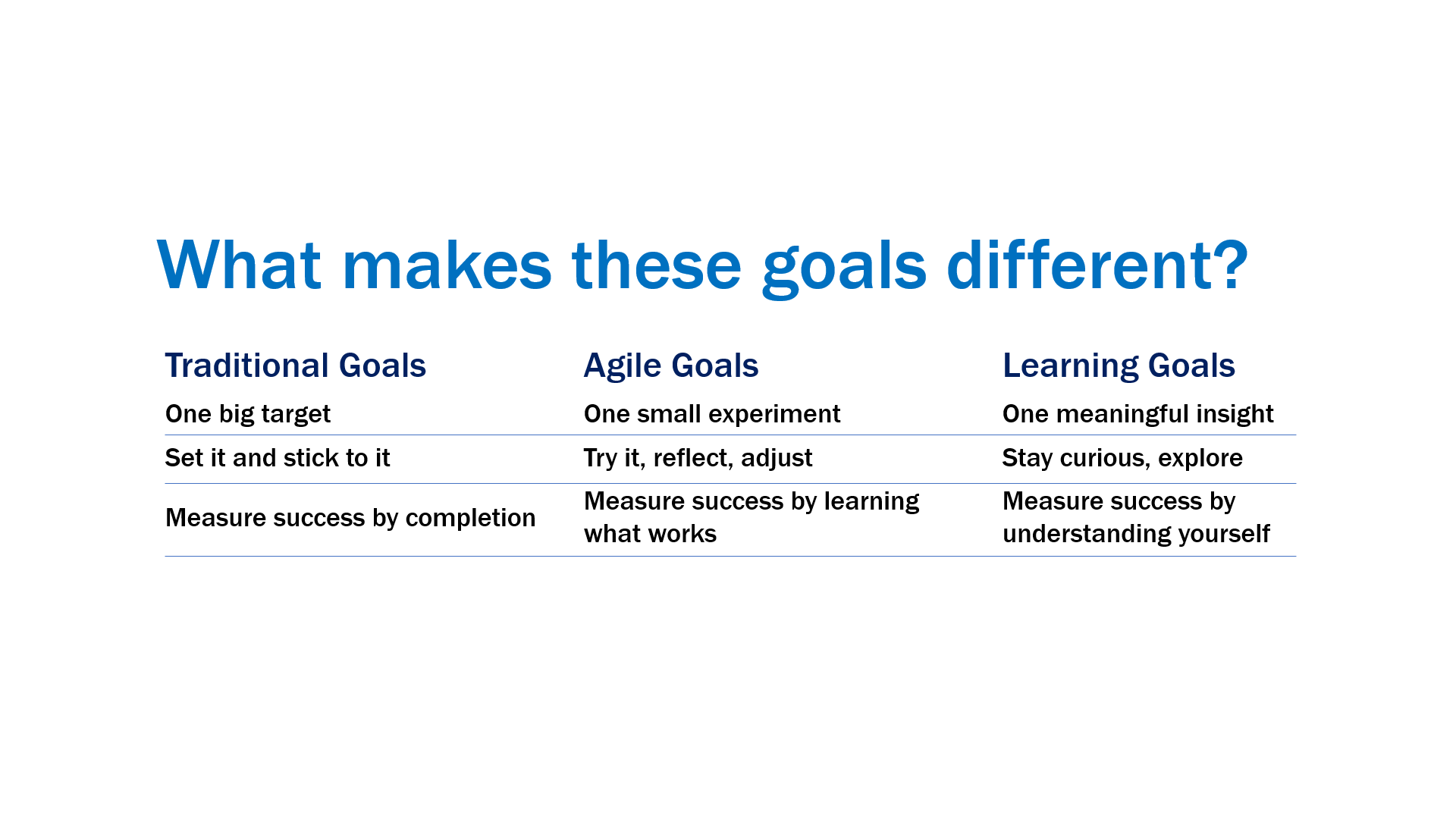
Agile goals are all about flexibility. You set a small goal, try it out for a short period (a few days or a week), see what works, and then adjust. No pressure to get it perfect—just a chance to test and learn. This is especially helpful when you're trying to shift routines or build habits in real life, not a lab.
Try this:
"I'll try this first recipe three days this week and see how it feels. If it goes well, I'll keep going. If not, I'll figure out why and adjust."
There's no "failing" here—just experimenting. You're gathering information about what fits you, not checking boxes on someone else's plan.
The purpose of setting goals is to win the game. The purpose of building systems is to continue playing the game. True long-term thinking is goal-less thinking. It’s not about any single accomplishment. It is about the cycle of endless refinement and continuous improvement. Ultimately, it is your commitment to the process that will determine your progress.
Clear, James. Atomic Habits: An Easy & Proven Way to Build Good Habits & Break Bad Ones (p. 27). Penguin Publishing Group. Kindle Edition.
Learning Goals: Focus on the How, Not Just the What
Learning goals are about understanding, not just accomplishing. They're especially useful when you're entering new territory—like building a different eating pattern, navigating energy dips, or learning what works for your unique body.
Instead of aiming for a fixed result, you aim to learn something meaningful along the way.
Try this:
"This week, I want to understand how protein at breakfast affects my energy in the afternoon. I'll try it a few different ways and jot down what I notice."
Notice how the focus is on curiosity, not discipline. That shift matters. It takes the pressure off and helps you build habits that last longer than a deadline.
Why This Matters
Most goal-setting advice assumes that life is stable and linear. But real life changes. Bodies change. Routines shift. And sometimes, we just don't know what we want yet—we're still exploring.
Agile and learning goals let you build momentum without the pressure. They help you stay engaged and curious instead of overwhelmed or discouraged.
Where to Start
When you're trying to change how you eat, you can ask yourself one of these questions:
What one thing can I do to make this meal easy?
What do I want to understand better about this meal or routine?
What worked last week? What might I shift slightly this time?
You don't have to figure it all out today. Just try, learn, and adjust.
That's progress.