Week 5 / Creating Ease

Habits are the compound interest of self-improvement. The same way that money multiplies through compound interest, the effects of your habits multiply as you repeat them. They seem to make little difference on any given day and yet the impact they deliver over the months and years can be enormous. It is only when looking back two, five, or perhaps ten years later that the value of good habits and the cost of bad ones becomes strikingly apparent.
Clear, James. Atomic Habits: An Easy & Proven Way to Build Good Habits & Break Bad Ones (p. 16). Penguin Publishing Group. Kindle Edition.
Make it stick
Eating is instinctual. Eating with intention—toward a specific goal—is a practice. We often confuse the two. But think about it: there’s no other meaningful practice in life where we expect to start from perfect and never mess it up. Mastery takes time, repetition, and reflection.
Even professional athletes don’t perform at peak every time. That’s part of what makes competition worth watching—circumstances change, outcomes shift, and even last week’s winner might be this week’s runner-up. But we forget that second place still reflects an elite performance.
For data’s sake
We use data in sports to understand how an athlete might perform under certain conditions—not as a guarantee, but as a trend. Data helps us make sense of the picture over time. But it’s only useful if we know what to measure and how to use it. A champion sprinter, for example, isn’t running all-out in practice. If they accidentally broke a world record during a warm-up, it wouldn’t tell us anything meaningful about race-day readiness. We’d be more interested in how consistently they stuck to their plan, how they recovered, and what kind of progress that consistency produced. Outlier performances don’t really tell us anything.
If they’re not following the plan, we can’t evaluate their performance in context. But here’s the more important question: if the athlete can’t follow the plan, is it their failure—or is the plan flawed?
That’s the real value of data: to see if your plan is working. Not to keep a perfect log, but to notice patterns. To understand what’s helping—and what’s getting in the way.
Aligning to outcomes
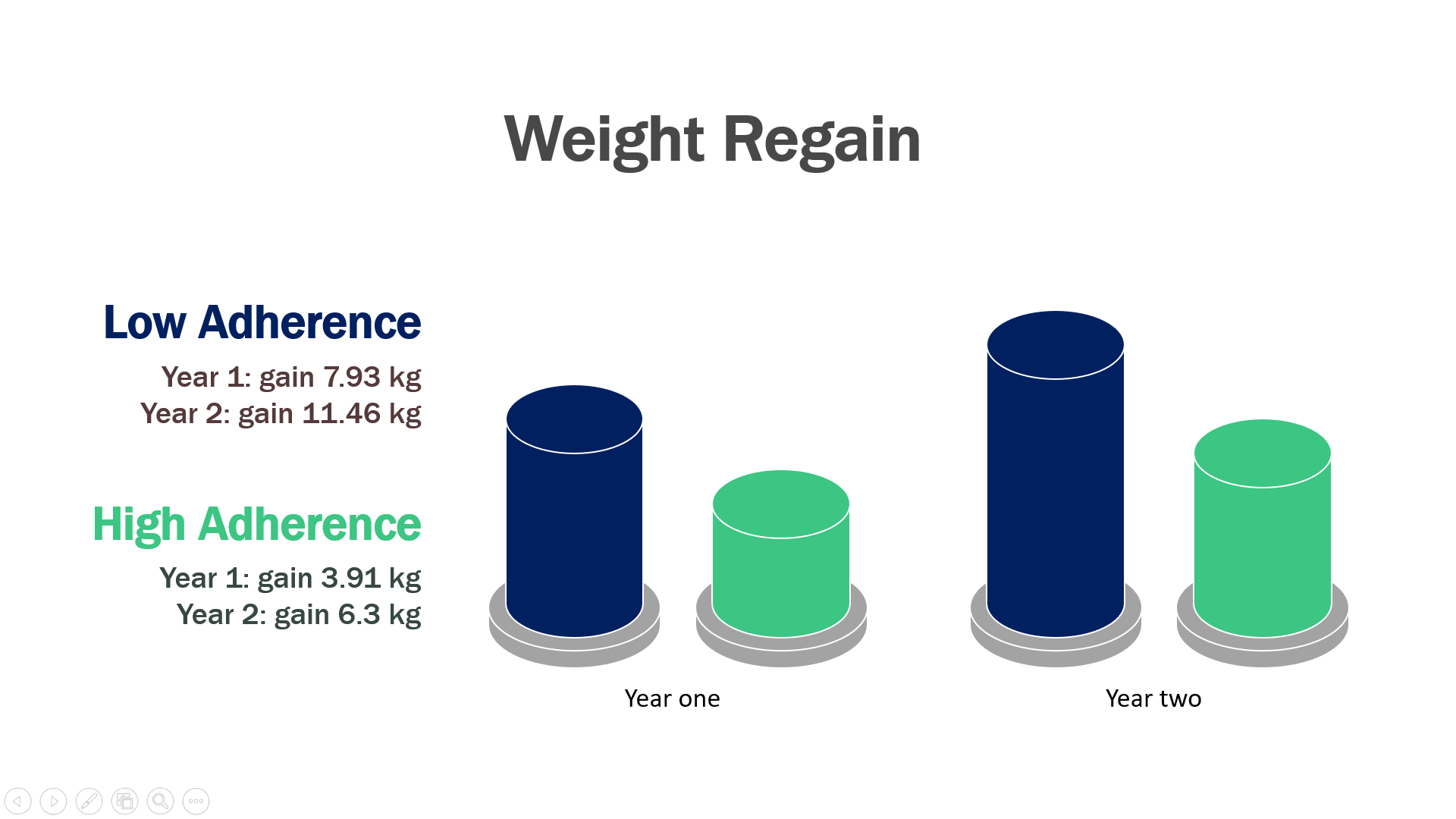
Let’s say your goal is to lose weight and keep it off. The most important data isn’t how much you lose during the plan, but what happens after. Research shows that most people regain some weight, in part because the body adapts to a calorie deficit. But there’s a consistent pattern: those with greater adherence gain back less.
Now, consider this: what if the strictest plan produced the biggest short-term loss and the biggest rebound? Would that short-term success matter if it made long-term success harder?
This is why sustainability—not speed—wins. A plan you can actually stick with will lead to better outcomes over time, even if it doesn’t produce the most dramatic results right away.
it doesn’t matter how successful or unsuccessful you are right now. What matters is whether your habits are putting you on the path toward success. You should be far more concerned with your current trajectory than with your current results.
Clear, James. Atomic Habits: An Easy & Proven Way to Build Good Habits & Break Bad Ones (p. 18). Penguin Publishing Group. Kindle Edition.
Grit or quit?
One of the hardest things to determine is whether your plan isn’t working or isn’t working YET. We constantly waver between quitting and giving it one more try. In this episode of ‘No Stupid Questions,’ the author of ‘Grit, ’ Angela Duckworth, and coauthor of ‘Freakonomics, ’ Stephen Dubner, discuss how to make that call.